
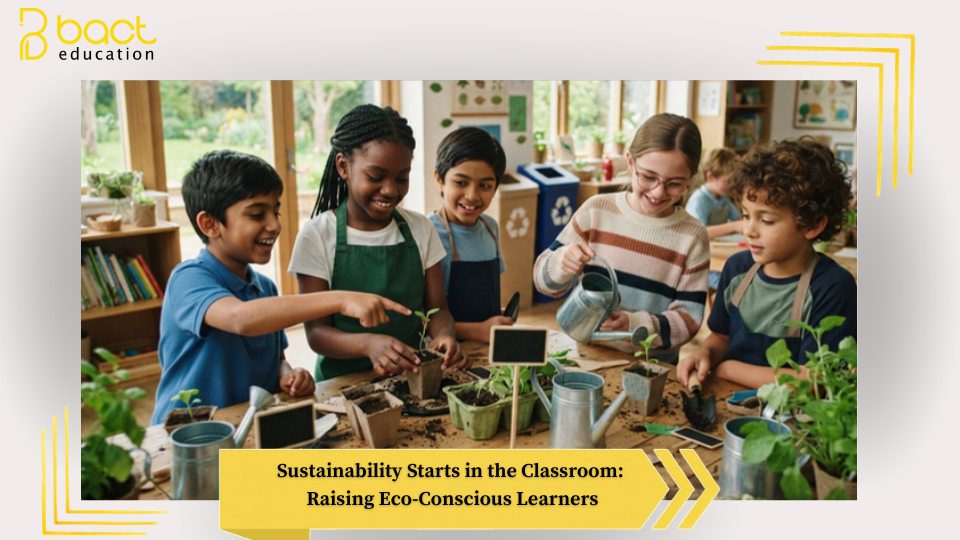
Sustainability Starts in the Classroom:
Raising Eco-Conscious Learners
In a world facing climate change, resource depletion, and growing environmental challenges, education has taken on a new responsibility—one that goes beyond academic success. Today’s classrooms are not just places of learning; they are spaces where future stewards of the planet are shaped.
Because sustainability isn’t just a subject—it’s a mindset, a habit, and a way of living.
Children are naturally curious about the world around them. They notice the smallest details—a fallen leaf, a buzzing insect, a drop of water slipping through their fingers. When we nurture this curiosity, we open the door to deeper understanding and responsibility.
What Does It Look Like in Schools?
Sustainability in education doesn’t require grand gestures. Often, it begins with simple, intentional practices such as:
- Encouraging students to reduce, reuse, and recycle within the classroom
- Creating school gardens where children learn to grow and care for plants
- Integrating environmental topics into everyday lessons—whether in science, geography, or even storytelling
- Organizing clean-up drives or eco-projects that connect learning to real-world action
These small steps help students see that their actions matter. Over time, they build awareness, responsibility, and a sense of ownership for the environment.
Learning Beyond the Textbook
When children engage with sustainability through hands-on experiences, learning becomes meaningful. A lesson on plants becomes more than diagrams—it becomes nurturing a living thing. A discussion about waste turns into mindful choices during lunch breaks.
This kind of learning stays with them, shaping not only what they know, but how they live.
The UAE’s Vision for a Greener Future
In the UAE, sustainability has become a national priority, reflected in initiatives like the UAE Ministry of Climate Change and Environment and long-term goals such as the UAE Net Zero 2050. Schools are increasingly aligning with these efforts by embedding environmental awareness into their curriculum and daily practices.
From energy-saving campaigns to eco-conscious school policies, students are growing up in environments that model sustainable living.
The Role of Families
Sustainability doesn’t end at school. When families reinforce these values at home—by reducing waste, conserving energy, or simply having conversations about the environment—children begin to see consistency between what they learn and how they live.
It becomes a shared responsibility, one that extends beyond classrooms into everyday life.
Planting Seeds for the Future
We often ask what kind of world we are leaving for our children. Perhaps we should also ask—what kind of children are we raising for the world?
By embedding sustainability into education, we are not just teaching concepts; we are shaping habits, values, and a sense of care for the planet.
Because every small action—a recycled bottle, a planted seed, a mindful choice—adds up.
And when children learn to care for the Earth, they grow into adults who protect it.
When we teach children to respect the planet, we are not just educating minds—we are nurturing guardians of the future.
