An Engine for Innovation in Education**
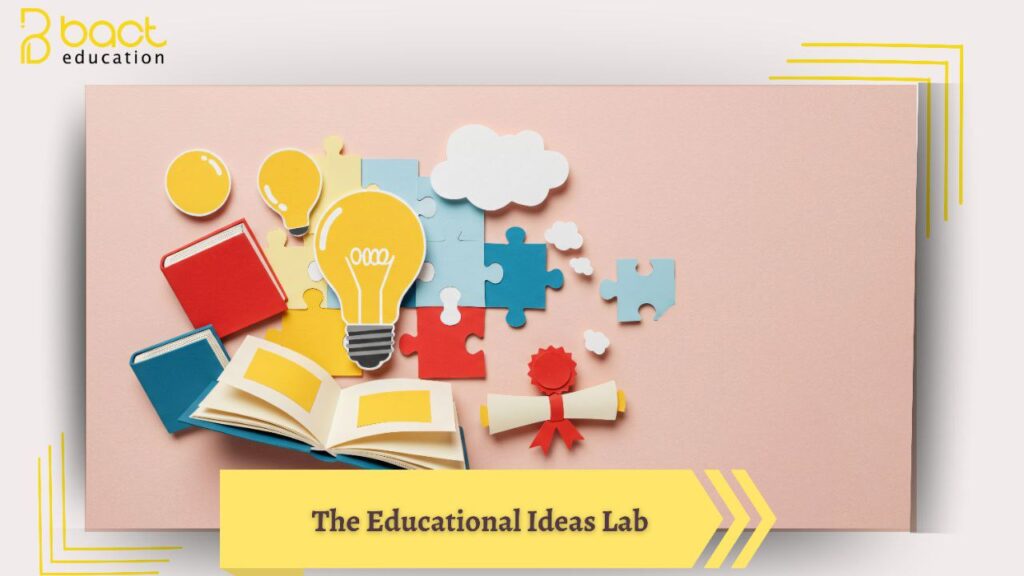
In an era of rapid change and complex challenges, the “Educational Ideas Lab” emerges as an urgent necessity for developing the educational system. It is not merely a physical space, but an interactive environment and a working methodology aimed at generating innovative solutions, experimenting with new educational models, and anticipating the future of teaching and learning.
**What is an Educational Ideas Lab?**
It is a safe and stimulating space that brings together educational experts, teachers, policymakers, and even students and community members. This space works on developing implementable ideas and projects through collaborative workshops, applied research, and prototyping to address educational challenges such as: the skills gap in relation to labor market needs, supporting marginalized groups, and the effective integration of technology.
**Goals of an Educational Ideas Lab:**
1. **Generate Creative Solutions:** Moving beyond traditional patterns to develop bold ideas for solving real-world problems, such as school dropout rates or learning difficulties.
2. **Experimentation and Measurement:** Testing new ideas on a small scale and collecting data to evaluate their effectiveness before scaling them up.
3. **Building Partnerships:** Creating bridges between different sectors (education, technology, civil society) to implement projects.
4. **Capacity Building:** Training teachers and educational leaders in methodologies like design thinking and innovative problem-solving.
**Components of a Successful Lab:**
* **Diverse Team:** Educators, learning experience designers, technologists, researchers.
* **Working Methodology:** Adopting methodologies like “Design Thinking,” which focuses on understanding the end-user (student/teacher) and iteratively testing solutions.
* **Supportive Resources:** Access to research sources, technological tools, and seed funding for promising ideas.
* **Intellectual Freedom and Safety:** An environment that encourages experimentation and does not punish failure, but rather learns from it as a step in the process.
**Practical Models:**
A lab can be an initiative within a single school to improve the classroom environment, a national program under the Ministry of Education to develop curricula, or a digital platform that gathers innovators in “EdTech.” Practical examples include: designing educational games for early-grade students, or creating virtual training programs for teachers in remote areas.
**Challenges:**
Educational Ideas Labs face challenges including: resistance to change within educational institutions, lack of sustainable funding, and the difficulty of measuring the long-term impact of innovative ideas.
**Conclusion:**
The Educational Ideas Lab is an investment in the future of education. It transforms challenges into opportunities and makes the process of educational development a dynamic, participatory process based on innovation and experimentation. By supporting these labs, we can build more resilient, inclusive, and capable educational systems to prepare future generations for the world of tomorrow.
