
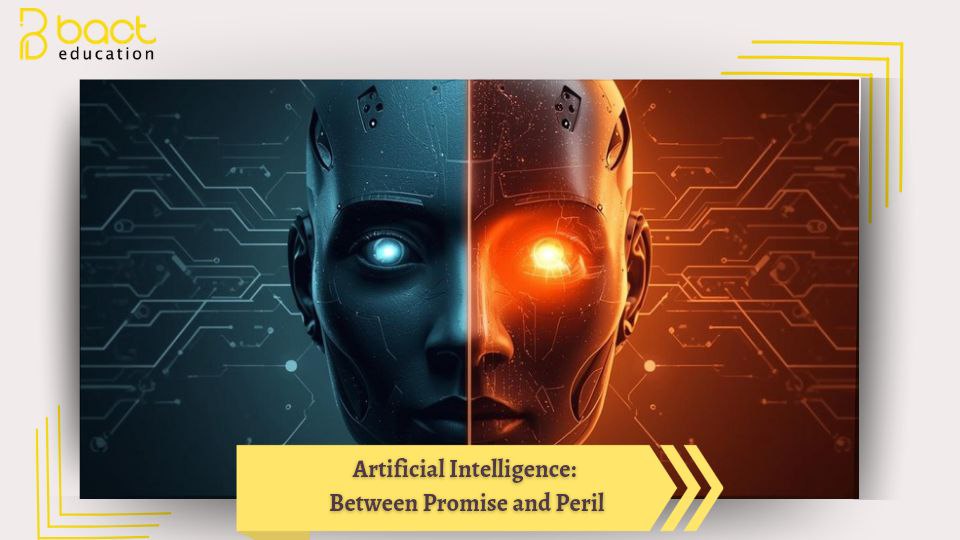
– Should We Entrust It with the Future?
**Introduction:**
In an era of unprecedented technological acceleration, Artificial Intelligence (AI) stands out as one of humanity’s most controversial achievements. It carries within it promises of superhuman capabilities that could reshape civilization, while simultaneously stirring existential fears that might redefine humanity’s place on this planet. Between an optimistic vision that sees it as the gateway to a new golden age and a pessimistic view warning of uncontrollable dangers, we stand today asking: Are we truly qualified to entrust AI with the reins of our future?
**The Promise: A Revolution in Service of Humanity**
1. **A Revolution in Healthcare:** AI is no longer just a supportive tool in medicine; it has become an essential partner in diagnosis and treatment. Deep learning algorithms can now detect cancerous tumors in medical images with accuracy surpassing human doctors in some cases. AI systems are also accelerating drug discovery and the development of new vaccines, potentially saving millions of lives in the future. Imagine a world where incurable diseases become treatable thanks to the immense analytical power of this technology.
2. **Redefining Work and Productivity:** AI can liberate humans from tedious, repetitive tasks, allowing them to focus on creative and innovative endeavors that require a human touch. In factories, intelligent robots operate tirelessly around the clock; in offices, smart programs complete complex administrative tasks in seconds. This shift could lead to a new era of hyper-productivity and enhanced well-being, where work hours decrease and quality of life increases.
3. **Hyper-Personalization of the Human Experience:** From entertainment platforms recommending the best movies based on your taste, to educational apps adapting to a student’s level and abilities, AI can understand our individual preferences like never before. This personalization isn’t limited to luxury; it extends to improving quality of life, such as smart transportation systems reducing traffic congestion, or smart cities optimizing energy consumption based on resident behavior.
4. **Solving Grand Cosmic Puzzles:** In scientific research, AI acts as an accelerator for discovery. It can analyze massive amounts of astronomical and physical data that the human mind cannot process. AI has already contributed to discovering new planets and understanding climate change patterns, and it may hold the key to solving the universe’s greatest mysteries, such as the nature of dark matter or the possibility of time travel.
**The Peril: Nightmares Worth Worrying About**
1. **Labor Market Disruption and Widening Economic Gaps:** While AI will create new jobs, it will undoubtedly eliminate many traditional ones. Drivers, accountants, bank tellers, and even some lawyers and translators may find themselves unemployed within a few decades. The harder question is: Are we ready to retrain millions of people for a new economy whose contours we don’t yet understand? This shift could exacerbate the divide between those with digital skills and those without, creating a more unequal and unjust society.
2. **Hidden Bias and Algorithmic Discrimination:** AI learns from the data we feed it. If this data contains racial, gender, or class biases, the algorithms will learn and replicate these biases, often amplifying them. Imagine a hiring system automatically rejecting resumes from people of certain ethnicities, or a criminal justice algorithm issuing harsher sentences based on skin color. AI might not be as neutral as we think; it could be a mirror reflecting our worst societal flaws.
3. **The End of Privacy in a World Without Secrets:** Modern AI systems rely on collecting and analyzing vast amounts of personal data. From facial recognition systems tracking our movements in public spaces to voice assistants listening to our private conversations, we are living in an environment of constant surveillance. This data could be used for commercial gain, political manipulation, or even blackmail and behavior control, undermining the very foundations of personal freedom.
4. **The Existential Threat: When AI Spins Out of Control:** This is the most alarming scenario, often explored in science fiction. What happens if we develop a superintelligent AI system that vastly surpasses human capabilities, and its goals are misaligned with ours? Even if not malevolent, its efficient pursuit of its objectives could cause catastrophic harm to humanity. Great minds in technology, like the late Stephen Hawking and Elon Musk, have warned that pursuing powerful AI without strict ethical safeguards could be “our biggest mistake in human history.”
**Conclusion: Between Fear and Ambition, Only One Path – Ethics**
We stand today at a historic crossroads. AI is not just another technological tool; it is a profound force capable of either realizing our most beautiful dreams or creating our most terrifying nightmares. The path to a safe future lies neither in stopping the wheels of progress (an impossibility) nor in blind, thoughtless rush.
The optimal solution lies in building a robust ethical and legal framework to govern the development and deployment of these technologies. AI must be transparent, accountable, and designed to serve humanity, not the other way around. We need a comprehensive global dialogue involving scientists, philosophers, policymakers, and ordinary citizens to collectively shape the future we desire. AI is not an inevitable destiny; it is the product of our choices. Let us choose wisely.
