
# Introduction
Human communication is not limited to spoken or written words. In fact, studies indicate that over 60% of the meaning in any social interaction is conveyed through non-verbal channels. Non-verbal communication is that subtle fabric of signals, movements, glances, and tones of voice that accompany our speech or sometimes replace it. It is the most honest language, as it often reveals what we hide in our words and expresses our deepest feelings before we can articulate them. Understanding this complex language is the key to emotional intelligence and successful human relationships.
#### First: Definition and Importance of Non-Verbal Communication
Non-verbal communication is the process of conveying information and feelings without using spoken words. The core of its importance lies in its ability to operate on multiple levels simultaneously: it supports and reinforces spoken words, or it may contradict them, revealing true intentions. In situations where words fail, such as moments of deep sorrow or immense joy, non-verbal communication becomes the primary tool. It is also essential for building trust and relationships, as people tend to believe body language more than words when there is an inconsistency between them.
#### Second: Key Elements of Non-Verbal Communication
This type of communication consists of several systems working together:
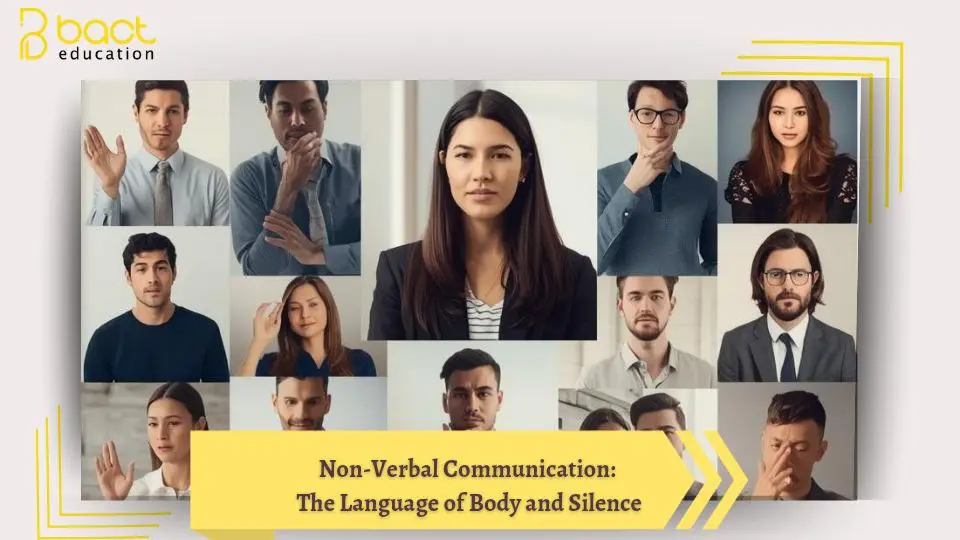
1. **Body Language (Kinesics):** This includes head gestures (like nodding in agreement), sitting or standing postures that reflect confidence or closed-off attitudes, and hand movements accompanying speech, whose meanings vary across cultures.
2. **Facial Expressions:** The face is the most expressive part of the body. It can convey six basic universal emotions (happiness, sadness, anger, fear, surprise, disgust) as well as hundreds of complex blends. A smile, for example, does not always mean happiness; there is the genuine Duchenne smile that reaches the eyes, and the polite, social smile.
3. **Eye Contact (Oculesics):** The eyes are the “window to the soul,” as they say. Prolonged glances can express interest or challenge, while avoiding eye contact might indicate shyness, discomfort, or even deception. Regulating eye contact is a subtle social skill.
4. **Proxemics:** This concerns our use of space and the distances we maintain between ourselves and others. There is the intimate distance (for loved ones only), personal distance (for friends), social distance (for formal interactions), and public distance (for public speaking). Intruding upon these distances without permission causes discomfort.
5. **Haptics and Chronemics:** Haptics involves the language of touch (handshakes, pats on the back) and its meanings of support or dominance. Chronemics concerns the use and perception of time (punctuality as a sign of respect in some cultures).
6. **Paralanguage:** This is not about the words themselves, but how they are spoken: tone of voice, speech rate, volume, and pauses. The sentence “I’m happy to see you” can mean the exact opposite if said with a cold or sarcastic tone.
#### Third: Cultural Differences in Non-Verbal Communication
One of the most dangerous pitfalls in cross-cultural communication is assuming that non-verbal signals have universal meanings. A gesture meaning “yes” in one culture (like nodding the head) might mean “no” in another (like in Bulgaria). Direct eye contact is considered a sign of honesty and confidence in the West, but it can be interpreted as rudeness or harassment in some Asian cultures. Personal space also varies greatly; Latin Americans and Arabs tend to prefer closer distances than Northern Europeans. Awareness of these differences is crucial to avoid misunderstandings in a globalized world.
#### Fourth: Functions of Non-Verbal Communication in Daily Life
Non-verbal communication serves several vital functions:
– **Repetition:** Reinforcing the verbal message (e.g., saying “yes” while nodding).
– **Contradiction:** Sending a signal that conflicts with the spoken words (e.g., saying “I’m fine” with a deep sigh and a sad look).
– **Complementing:** Adding emotional depth to speech (e.g., hugging someone while saying “I miss you”).
– **Regulating:** Using glances or movements to signal that we have finished speaking or wish to respond.
– **Substituting:** Using a silent gesture instead of speech (e.g., making a “shush” gesture with a finger to the lips).
#### Fifth: Conclusion: Towards More Conscious Communication
Non-verbal communication is the hidden, most honest dimension of our daily interactions. It is the language that does not lie, speaking louder than words. By developing our ability to read these signals and understand their meanings, and by becoming aware of the messages we unconsciously send, we can significantly improve the quality of our personal and professional relationships. It is a journey of discovering the meaning behind the silence, the subtle movement, and the fleeting glance.
