
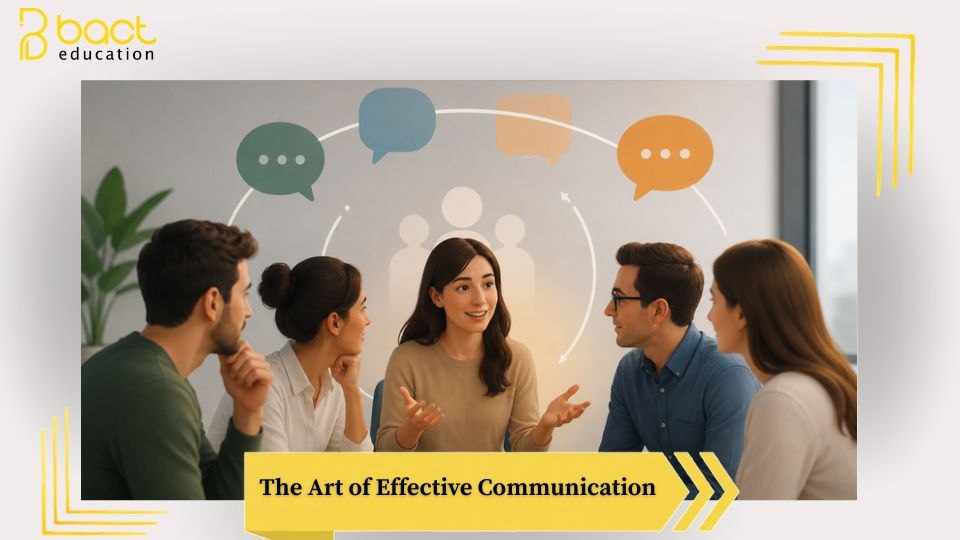
The Key to Success in Personal and Professional Relationships**
**Introduction:**
In an increasingly interconnected and complex world, effective communication is no longer just an additional soft skill; it has become an absolute necessity for success in all walks of life. Whether it involves building strong personal relationships, leading a team to achieve goals, or even understanding oneself on a deeper level, the ability to convey thoughts and emotions accurately and clearly, and to receive them with empathy and understanding, is the cornerstone of any successful human interaction. Effective communication is a refined art that goes beyond mere word exchange to encompass body language, tone of voice, and active listening.
**Components of Effective Communication:**
Good communication is not just about speaking fluently; it consists of several integrated elements:
1. **Clarity and Conciseness:** The ability to express an idea using the simplest and most direct words, avoiding complexity and ambiguity. The listener is not a mind-reader.
2. **Active Listening:** This is more than just hearing words; it is complete focus on the speaker, understanding their perspective, and interacting with them using questions and comments that show genuine interest. Active listening also involves observing body language and tone of voice.
3. **Empathy:** The ability to put oneself in another’s place, understanding their feelings and needs without passing judgment. Empathy builds bridges of mutual trust and respect.
4. **Body Language (Non-Verbal Communication):** Gestures, facial expressions, eye contact, and posture all send powerful messages that can either contradict or affirm our spoken words. Alignment between verbal and non-verbal cues enhances credibility.
5. **Constructive Feedback:** The ability to give an opinion or criticism in an objective and constructive manner, focusing on the behavior and not the person, aiming for improvement rather than offense.
**Barriers to Effective Communication:**
Several obstacles hinder effective communication, including:
– **Psychological Noise:** Such as being preoccupied with personal thoughts, anxiety, or having a preconceived bias against the speaker.
– **Assumptions:** When we think we know what the other person is going to say before they finish.
– **Language Barriers:** Using complex vocabulary or slang that the other party does not understand.
– **Differences in Cultural Backgrounds:** Communication styles and the meaning of gestures vary greatly from one culture to another.
**Tips for Improving Your Communication Art:**
1. **Practice Listening:** Dedicate time to listen without interrupting, focusing on what is truly being said.
2. **Think Before You Speak:** Organize your thoughts and choose your words carefully.
3. **Monitor Your Body Language:** Ensure it reflects what you are saying (smile, make eye contact, sit in an open posture).
4. **Ask for Clarification:** Do not hesitate to ask clarifying questions like, “Do you mean that…?”
5. **Be Open to Criticism:** Accept feedback graciously and consider it a learning opportunity.
**Conclusion:**
The art of effective communication is a continuous journey of learning and development, not a final destination. It is the skill that distinguishes successful individuals in their personal and professional lives. By investing in improving how we communicate with others, we invest in building healthier relationships, more successful opportunities, and a life with greater understanding and humanity. Start today with one small step: listen more, speak clearly, and notice the difference.
