
## Introduction
We are living in an era of unprecedented technological transformation, where automation and artificial intelligence are radically reshaping the employment landscape. These technologies are no longer theoretical concepts confined to research labs; they have become integral forces redefining the nature of work and the skills required in the labor market. While some fear an uncertain future where traditional jobs disappear, experts indicate that automation carries immense opportunities for those who prepare properly .
## Job Displacement: Between Threat and Opportunity
Estimates suggest that automation could displace hundreds of millions of jobs globally. According to a 2023 McKinsey report, between 400 and 800 million jobs could be displaced by 2030, requiring as many as 375 million workers to switch occupational categories . The World Economic Forum predicts that approximately 92 million jobs may be displaced by 2030 .
However, these figures do not tell the complete story. Jobs are not merely disappearing; they are transforming and evolving. In East Asia and the Pacific, for instance, robot adoption helped create jobs for an estimated 2 million skilled formal workers, although it displaced approximately 1.4 million low-skilled formal workers . This illustrates that the impact is uneven, with skilled workers benefiting while less-skilled workers bear the greater burden.
## Skills Required in the Age of Automation
As routine tasks become automated, new skills that machines cannot easily replicate are emerging. A recent McKinsey Global Institute study indicates that social and emotional skills—such as emotional intelligence, empathy, and ethical judgment—remain beyond the reach of automation even under full-adoption scenarios .
Key skills required include:
1. **Advanced Digital Skills**: Workers need the ability to effectively use digital devices, applications, and platforms .
2. **Social and Emotional Skills**: Such as leadership, interpersonal communication, and strategic vision, which give humans a comparative advantage over machines .
3. **Specialized Technical Skills**: Including AI development, data analysis, cybersecurity, and robotics engineering .
4. **Continuous Learning Capability**: Lifelong learning has become essential to keep pace with accelerating changes .
## How to Adapt to the Future?
Experts suggest several strategies for thriving in the age of automation:
– **Embrace Continuous Learning**: Enroll in online courses to acquire new skills in areas such as machine learning and cloud computing .
– **Seek Growth Sectors**: Such as healthcare technology, renewable energy, and cybersecurity .
– **Develop Human-Centric Skills**: Including leadership, strategic vision, and emotional intelligence .
– **Collaborate with Automation Rather Than Compete Against It**: Understand how to use AI tools to enhance productivity and focus on high-value tasks .
## Human-Machine Collaboration: The Future Model
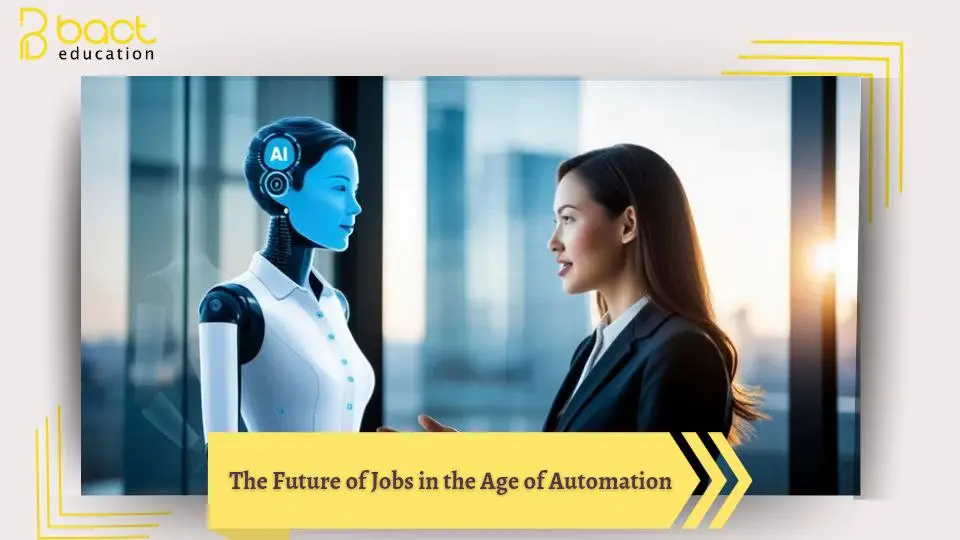
Experts agree that the future of work is not about replacing humans with machines, but rather creating an effective partnership between them. In manufacturing, for example, robots can handle repetitive and physically demanding tasks, freeing workers to focus on more complex activities such as quality management and innovation .
A McKinsey report emphasizes that the future workforce will increasingly resemble a three-way partnership between humans, AI agents, and robots, with humans directing workflows, ensuring safety, and bringing ethical judgment to decisions that AI cannot navigate alone .
## Conclusion
The age of automation represents a fundamental shift in the concept of work and jobs, but it is not the end of work as we know it. Success in this new era requires preparation and adaptation through developing appropriate skills and embracing a mindset of continuous learning. As experts note, the future belongs neither. to humans alone nor to machines alone, but to the intelligent partnership between them .
Opportunity remains available for those who prepare properly. The question is not whether automation will change the world of work, but how we can actively participate in shaping this future rather than merely watching it unfold.
