
**Introduction:**
Children naturally learn through trial and error, and it’s perfectly normal for them to make mistakes from time to time, whether at home or in public. However, the situation becomes more sensitive when that mistake happens in front of strangers; the child may feel embarrassed, and parents might feel social pressure or fear of judgment from onlookers. The challenge lies in how to guide the child in a way that preserves their dignity, teaches correct behavior, and doesn’t break their spirit or increase their shyness. The way we handle our children’s mistakes in front of others has a profound impact on their personality and self-confidence.
**Why is Guidance in Front of Strangers So Sensitive?**
– The child feels shame or fear of humiliation.
– Parents may feel pressure from “what people will say.”
– Harsh correction (like yelling or insulting) can send the message that the child is “bad” rather than that their “behavior was inappropriate.”
**Practical Tips for Guiding Your Child Gently and Effectively:**
**1. Don’t Correct the Mistake Immediately in Front of Everyone (If Not Dangerous):**
If it’s a minor mistake (e.g., saying an inappropriate word, gently pushing another child), it’s better to ignore it momentarily and wait until you are away from public view. Immediate public correction can hurt the child’s feelings and make them more defiant. However, if the mistake involves danger (e.g., running in a parking lot), immediate intervention is necessary, but with minimal noise.
**2. Bend Down to Their Level and Speak Calmly:**
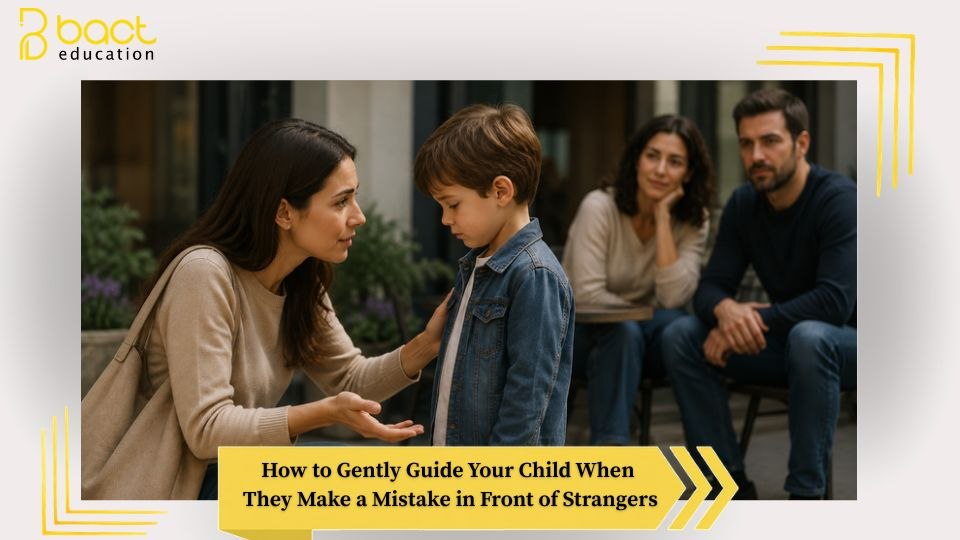
Instead of shouting from a distance, approach your child, bend down so your eyes are level with theirs, and whisper or speak in a low, calm voice. This prevents embarrassment in front of strangers and helps them focus on your words. For example: “Come on, let’s step over here for a moment.”
**3. Use Positive, Clear Phrases that Focus on the Behavior, Not the Child’s Identity:**
Instead of saying: “You are a bad/rude child,” say: “That action wasn’t right. We don’t shout in a restaurant.” Separating the child from the behavior protects their self-esteem.
**4. Explain WHY the Behavior Was Wrong:**
Children learn best when they understand the reason. Calmly say: “When you took that toy from the other boy’s hand without asking, he felt sad. How would you feel if someone did that to you?”
**5. If an Apology is Needed, Coach Them Without Forced Humiliation:**
Don’t force a shy child to apologize in front of strangers and leave them feeling humiliated. Instead, you can model the apology: “Let’s apologize together. Say with me: ‘I’m sorry, I didn’t mean it’.” Or you can apologize on their behalf while placing a hand on their shoulder: “I apologize on his/her behalf; it wasn’t intentional.” This teaches responsibility without causing psychological distress.
**6. Avoid Comparing Them to Other Children in Front of Strangers:**
Comparisons like “Look at that girl, how quietly she’s sitting!” make the child feel worthless and plant seeds of jealousy and resentment.
**7. After Leaving, Discuss the Incident Calmly:**
When you are alone (in the car or at home), talk about what happened. Ask: “What happened back there? What could we have done differently?” This reinforces learning without the pressure of an audience.
**8. Protect Your Child from Judgmental Looks from Strangers:**
If you notice someone staring or making an inappropriate comment, you can politely stand up for your child: “Children are learning, thank you for your understanding.” This teaches the child that you are always on their side.
**Conclusion:**
Guiding your child when they make a mistake in front of strangers is not a test of your ability to control them; it is an opportunity to teach valuable social skills in a way that preserves their human dignity. Remember that a child who is raised with kindness and respect in public spaces will grow up to be a confident person, capable of taking responsibility, and more empathetic toward others’ mistakes. Patience, calmness, and choosing the right time and place for correction are your keys to raising a balanced child without breaking their spirit in front of strangers.
